
Safety is a top priority in construction due to the high-risk nature of the work environment.
Workers face hazards from heavy machinery, elevated work areas, and unpredictable environmental conditions.
Maintaining a secure site not only protects lives but also boosts productivity and ensures compliance with regulatory standards.
Technology can support day-to-day monitoring, while lanahan risk management services can help businesses with fire risk assessments, health and safety audits, policy development and tailored training.
Part of ensuring safety is providing the right workwear and safety gear, including uniforms and protective clothing suitable for construction work.


Artificial intelligence (AI) combined with computer vision has transformed safety management on construction sites.
These technologies enable real-time hazard detection, worker behavior monitoring, and equipment oversight, allowing proactive measures to mitigate risks and create a safer, more efficient workplace for everyone.
1. Real-Time Hazard Detection
AI uses advanced algorithms and computer vision to continuously scan construction sites for potential hazards.
It can identify obstacles, unstable structures, or dangerous materials that may not be easily noticeable to human workers.
This capability is vital, as the construction sector accounted for 46.2% of fatal falls, slips, and trips in 2021.
By providing instant alerts to site managers and employees, AI allows immediate action to address safety threats, significantly reducing accident risks.


2. Monitoring Worker Behavior
AI systems track workers’ movements and behaviors through sensors and computer vision to ensure compliance with safety protocols and detect risky actions.
They observe activities such as maintaining safe distances from dangerous zones, proper lifting techniques, and adherence to safety rules.
By analyzing patterns and highlighting deviations, AI alerts supervisors to unsafe practices. This proactive oversight fosters a safer working environment while reinforcing safe habits among employees, reducing the likelihood of injuries.
3. Environmental Oversight
AI continuously monitors environmental factors on construction sites, including dust, noise, and air quality, to maintain safe and compliant conditions. Sensors and data analytics help detect excessive pollutants or harmful levels of noise, prompting corrective measures.
Regular monitoring is especially important during extreme weather, which can lead to costly damage or unsafe conditions.
For example, AI can track dust levels in real time and activate water sprays to minimize airborne particles, protecting workers’ health.

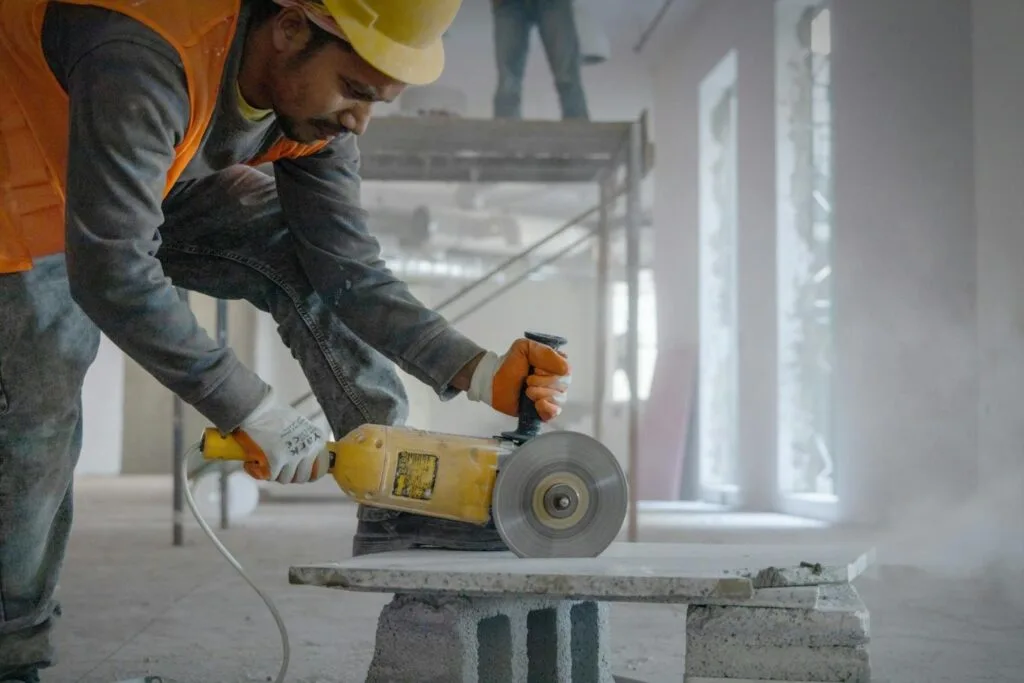
4. Ensuring Proper Use of Personal Protective Equipment
AI-driven computer vision verifies that workers are wearing the correct personal protective equipment (PPE).
Using sophisticated algorithms, AI systems can analyze visual data and recognize patterns in real time, even for previously unseen scenarios.
By scanning workers as they move through the site, AI confirms the use of helmets, gloves, vests, and other essential safety items.
If a worker is missing critical gear, the system immediately notifies site managers to take action, ensuring compliance with safety standards.
This technology works best when paired with protective uniform built for work from Yurinox Workwear providing both comfort and protection in demanding work environments.
5. Equipment and Machinery Safety
AI monitors machinery and equipment operations, analyzing sensor and camera data to ensure safe usage and prevent accidents. Between 2018 and 2020, contact with objects or equipment caused over 32% of injuries in construction, underscoring the importance of vigilant monitoring.
AI can detect anomalies, such as overheating, unusual vibrations, or unsafe positioning, and alert supervisors.
For instance, if an excavator approaches a trench edge too closely, AI can immediately signal intervention to prevent accidents.


6. Perimeter Security and Intrusion Detection
AI enhances construction site security by monitoring perimeters in real time and identifying potential threats.
These systems complement manual security measures, reducing false alarms while maintaining robust protection.
Computer vision can detect unauthorized entry, suspicious activity, vandalism, or theft, allowing swift responses.
For example, AI-powered cameras can alert security personnel to break-in attempts during off-hours, preventing damage and loss.

7. Predictive Maintenance
AI also supports predictive maintenance by analyzing sensor data and historical records to anticipate equipment failures. This approach minimizes downtime and prevents accidents caused by malfunctioning machinery.
Additionally, AI integrates with wearable devices and building information modeling (BIM) to identify fall hazards and other risks.
For example, detecting a potential crane malfunction before it occurs allows for timely repairs, avoiding critical failures and maintaining overall site safety.
Embracing AI for Safer Construction
AI’s role in construction safety continues to expand, offering more precise hazard detection, predictive maintenance, and real-time monitoring.
By adopting AI-powered computer vision systems and providing workers with proper apparel and workwear, construction sites can improve safety outcomes, reduce incidents, and enhance operational efficiency.