
In the pursuit of creating a home theater experience that mirrors the magic of cinemas, the Laser TV projector has emerged as an innovative solution.
These cutting-edge devices are a far cry from the cathode ray tube (CRT) televisions that once dominated our living rooms, showing how far technology has traveled in the pursuit of enhanced entertainment.
CRT televisions, which were the backbone of home entertainment for much of the twentieth century, relied on vacuum tube technology to generate images.
Although groundbreaking at the time, they were big, inefficient in terms of energy, and offered poor resolution.
The flat-screen era has here, with LED and LCD televisions offering dramatically improved visual quality, thinner designs, more energy efficiency, and higher resolution.
In the recent decade, home entertainment technology has taken another step forward, with laser TV projectors threatening the dominance of traditional televisions.

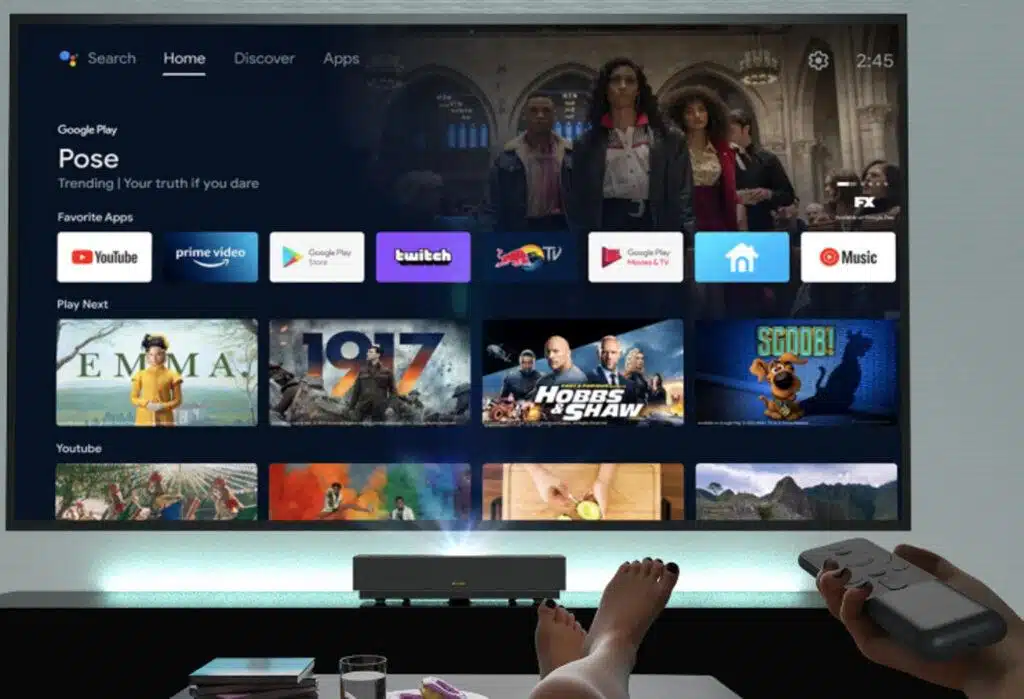
According to industry analysts, the global laser projector market is likely to increase dramatically in the coming years, indicating a shift in customer preferences.
So, what are the benefits of laser TV projectors that make them a desirable option? For starters, these devices outperform traditional televisions in terms of color accuracy and brightness levels. Viewers can experience beautiful, lifelike colors even in well-lit spaces thanks to the laser light source.
Additionally, laser TV projectors are scalable. Instead of being limited to a fixed screen size, the projected image may be adjusted to match any wall or projector screen in your home. Because of this versatility, you can create a fully cinematic experience without the space limits of traditional television.
Laser TV projectors also outperform in terms of lifespan. These projectors’ light sources can last up to 20,000 hours, which is far longer than standard bulbs.
This means fewer replacements and significant savings throughout the projector’s lifespan.
Ultra-short throw (UST) laser projectors are another example of technological advancement. These gadgets can project a large image from just a few inches away, removing the need for a vast space to produce a large viewing experience.
However, laser TV projectors have significant drawbacks like with any emerging technology. Notably, their high initial cost may dissuade some customers.
But given their lifespan, scalability, and the quality of viewing experience they provide, many people regard them as a good long-term investment.
Keep in mind that a correct setup is required to fully utilize a laser TV projector. This requires a good projection surface as well as smart placement to avoid shadows.
Some versions also necessitate external audio systems to match the outstanding sights with equally impressive sound.
Surprisingly, laser TV projectors are rapidly combining with augmented reality (AR) and virtual reality (VR) technology to further transform home entertainment.
Several manufacturers are testing laser projection systems that can generate 3D images without the use of special glasses. Such innovations have the potential to produce even more immersive and engaging experiences, bringing the wonder of theatres and beyond into the comfort of our own homes.
The progression of home projectors from cathode rays to lasers reflects our never-ending drive for richer, more immersive entertainment experiences.
As the twenty-first century progresses, the benefits of laser TV projectors – their versatility, longevity, and remarkable visual performance – make them an appealing offer for the future of home entertainment.
However, like with any technology, careful thinking and adequate setup are required to fully appreciate its potential.
Furthermore, the environmental impact of laser TV projectors should be considered.
Laser light sources use less energy than typical light bulbs used in older projectors and CRTs. This efficiency reduces power use, contributing significantly to greener, more sustainable home entertainment.
Finally, the transition from cathode rays to laser projectors demonstrates the unrelenting growth of technology in the service of improving our entertainment experiences.
With their stunning graphics, adaptability, lifespan, and the potential for immersive AR and VR experiences, laser TV projectors herald a bright future for home entertainment.
They also represent the ongoing problem of balancing breakthrough technologies with practicality, cost-effectiveness, and environmental responsibility.
One thing is certain as we negotiate this ever-changing landscape: our search for the best home entertainment experience is far from over.