
Winslow Homer is a renowned American artist whose works have left an indelible mark on the world of art.
From his early days as a commercial illustrator to his later achievements as a master painter, Homer’s artistic journey is a testament to his unwavering talent and dedication to his craft.
In this article, we will delve into the evolution of Winslow Homer’s art, from his initial foray into realism to his eventual transition into romanticism, and explore how his unique style and subject matter have made him a prominent figure in the realm of American art.

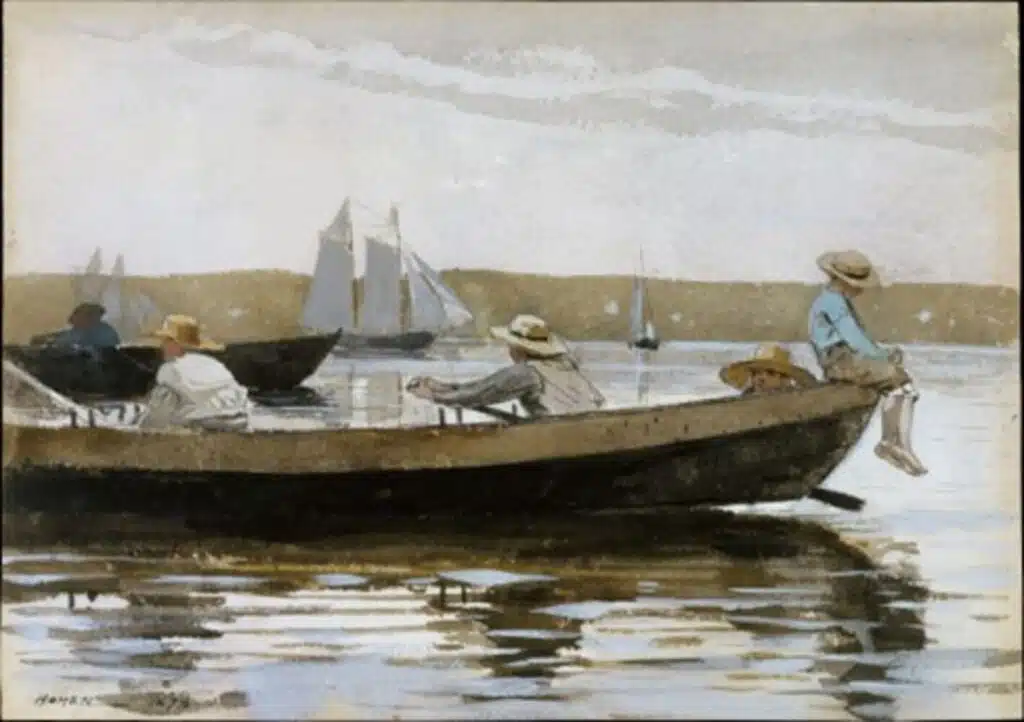
Early Years and Realism
Born in 1836 in Boston, Massachusetts, Winslow Homer initially pursued a career as a commercial illustrator, creating illustrations for newspapers, magazines, and other publications.
His early works were characterized by a meticulous attention to detail and a keen observation of everyday life.
Homer’s realistic approach to art was evident in his depictions of scenes from nature, as well as his portrayals of ordinary people engaged in everyday activities.
One of Homer’s notable works from this period is “Snap the Whip,” painted in 1872. This iconic painting depicts a group of young boys playing a game of tag, capturing the youthful exuberance and energy of the moment.
The use of vibrant colors and precise detailing in “Snap the Whip” showcases Winslow Homer’s keen eye for capturing the nuances of human movement and expression, making it a masterpiece of American realism.
Transition to Romanticism
As Homer’s career progressed, he began to explore different artistic styles and subject matters.
In the late 1870s, he shifted from the strict realism of his earlier works to a more romantic and impressionistic approach.
This marked a significant shift in his artistic style, as he began to experiment with looser brushstrokes, more dynamic compositions, and a greater emphasis on the play of light and color.
One of the notable works from this transitional period is “Breezing Up (A Fair Wind),” painted in 1873-1876. This painting depicts a group of fishermen in a small sailboat, braving the rough waves of the sea.
The use of bold brushstrokes and the dramatic play of light and shadow in “Breezing Up” showcase Homer’s growing mastery of the romantic style, as well as his ability to capture the raw power and beauty of nature.
Homer’s romantic works often featured maritime scenes, reflecting his fascination with the sea and his experiences as a young man working as a commercial illustrator for the maritime industry.
His depictions of the sea and seafaring life are imbued with a sense of awe and reverence, capturing the sublime beauty and grandeur of nature in a way that resonates with viewers on a deep emotional level.
Subject Matters and Symbolism
Throughout his career, Homer’s choice of subject matters was diverse, ranging from seascapes and landscapes to genre scenes and portraits.
He often drew inspiration from his surroundings, whether it was the rugged coastlines of Maine, the serene lakes of the Adirondacks, or the bustling streets of New York City.
His works are characterized by a sense of authenticity and a keen observation of human nature, capturing the essence of his subjects with great depth and nuance.
In addition to his skillful depictions of nature and human life, Homer’s works also often contain symbolic elements that convey deeper meanings.
For example, in his painting “The Gulf Stream,” painted in 1899, a lone African-American man is depicted stranded on a broken mast in the midst of a stormy sea.
This painting is widely interpreted as a reflection on the social and political issues of the time, including racial tensions and the plight of the individual against the forces of nature and society.
Conclusion
In conclusion, Winslow Homer’s art evolved from Realism to Romanticism, showcasing his mastery of capturing emotions, nature, and light.
His lasting legacy continues to impact the art world. Explore our website for more insights into this iconic American artist.