
Homeowners who think their work is done after picking up the countertop material for their kitchen are mistaken.
Instead, there’s one more crucial decision to make that is subtle and can help enhance the kitchen space’s aesthetic tone: what edge profiles would go best with the countertop they had chosen?
There are plenty of choices to choose from. But, a mitered edge profile is the one that looks great in any kitchen space. Its design element sets it apart from others.
It goes perfectly with quartz countertops. As they are durable, resistant and low-maintenance.
Go through this site to learn more about stylizing options with quartz countertops.

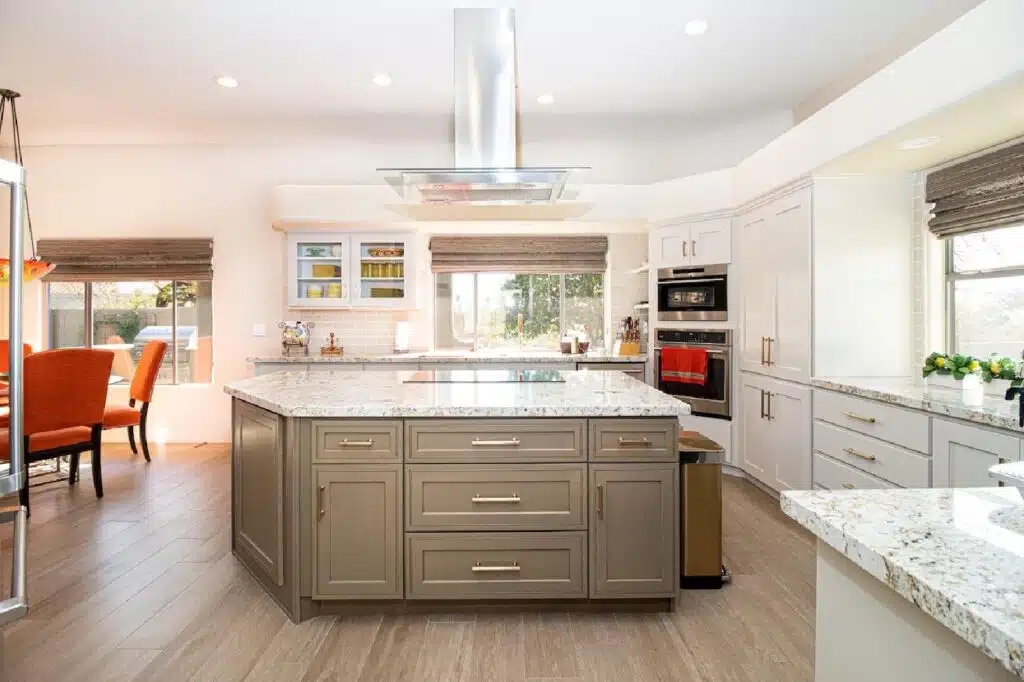
For now, let’s go through everything about mitered edge countertops and how they are an ideal option when it comes to renovating kitchen countertops:
What exactly are mitered edge countertops?
Countertops can look even more luxurious and richer the moment homeowners make the edge profiles become the focal point of their design.
This is where a mitered countertop edge comes to play.
It is a deviation from the design of the standard counter. It is constructed from two large slabs of stone that are cut at a 45-degree angle and manufactured such that the veining encircles the edges.
There won’t be any obvious joints, and the countertop or even the washbasin will appear to be one continuous slab of stone with veins extending into the adjacent section at the angle.
Why is a mitered edge countertop an ideal option for any kitchen space?
Kitchen countertops are an essential element of any design.
They are the focal point of the space. For homeowners looking for seamless style, the mitered edge is an ideal choice.
There are multiple reasons why one should choose this type of countertop.
Let’s have a look at them:
Give a seamless style to the kitchen’s interior.
Mitered edge countertops add a touch of sophistication and elegance to any kitchen space. In addition, it is more resilient than a countertop with a square edge.
The corners are cut at a 45-degree angle, which gives a seamless appearance that works well with both traditional and modern styles.
The mitered edge countertop is not only more resilient than conventional counters, but it is also simpler to maintain.
In addition, the seamless corners prevent the potential for mould or other buildups from forming where water can accumulate on corners.
Combines perfectly with vanities and cabinets
Mitered edge countertops are trending as they add a bit of luxury and intrigue to the kitchen space. They are more economical, aesthetically pleasing and durable compared to other types of countertops.
Plus, they can be easily matched with any type of cabinet and vanities to give a creative look to the kitchen space.
They may be a stunning addition to any kitchen thanks to their simple lines and refined elegance.
A room can be made more open and breezy by using bathroom vanities and cabinets with mitered edge countertops.
For those homeowners who want to get a minimalist style, use grey counters with wooden cabinets and vanities to produce some soft tones that will make the room appear larger.
Homeowners might pick them for their kitchen or bathroom because of their style compatibility or longevity.
Because there are no tricky angles to think about, installing these mitered countertops is often easier than installing other types of edge countertop.
In addition, they cost less because they require less material.
Easy to clean and maintain
Mitered edge countertops are becoming increasingly popular in today’s kitchens.
Thanks to their clean lines and minimalist design, they can help to give the kitchen a modern look. Mitered edge countertops are also easy to clean and maintain.
Because there are no sharp corners or difficult-to-reach areas, one can quickly wipe them down with a damp cloth.
In addition, mitered edge countertops are highly resistant to staining and scratches. As a result, they will continue to look new for many years to come.
For homeowners looking for a low-maintenance countertop option, mitered edge countertops are an excellent choice.
Things to consider when getting a mitered edge countertop


A mitered countertop is usually thicker than other countertop edges. Such countertops are typically heavier because they are thicker than the typical countertops.
For those homeowners who intend to surround it with a thicker slab of stone, any cabinets one intends to place beneath it must be sturdy enough to do so.
It will probably cost more to do this than installing a conventional countertop in traditional kitchens because the mitered edge will be thicker.
In addition, installation costs may also be higher due to the necessity for extreme caution to avoid cracking the extra thick countertop.
How much would homeowners have to pay?
Mitered edge countertop will cost far more than an edge that is squared or even bull-nosed.
In the case of a mitered edge, every side of the natural stone countertop will be the same thickness. A thinner slab countertop would obviously cost a lot less.
In addition, homeowners will need to account for the cost of installation as well as the weight-bearing capacity of any cabinetry installed beneath the countertop.
If necessary, one may need to modify the cabinetry to enable it to handle the heavier slabs of stone.
This implies that in addition to the price of the bigger slab of stone, the homeowner’s budget will also need to account for overhead expenses for a mitered countertop.
What is a mitered edge countertop? — Conclusion
Today’s kitchen trends are taking on modern looks. A mitered edge countertop can offer an appealing modern touch to the kitchen with its mesmerizing look.
Choosing this edge profile makes a bold statement in any kitchen space.
Its features, like the seamless look and ease of cleaning, make it a perfect choice for homeowners who are looking for a new and creative look for their kitchens.
The benefits of this edge profile outweigh its cons, and it is no wonder that homeowners and designers around the world are leaning toward this wonderful design