
Do you have old Canadian banknotes lying around somewhere? If so, they could be worth more than their face value.
Newer Canadian banknotes come with security features, like raised ink, which reduce the risk of counterfeiting and are designed to last longer than older bills.
To prevent older bills that lack security features from being used to make transactions, in early 2021 the government of Canada removed their status and took them out of circulation.
Now, you cannot use the following bills for transactions:
- $1
- $2
- $25
- $500
- $1,000
However, the Bank of Canada still honors the value of these old banknotes, and you can deposit them at your local bank for their face value—at least, you should be able to.

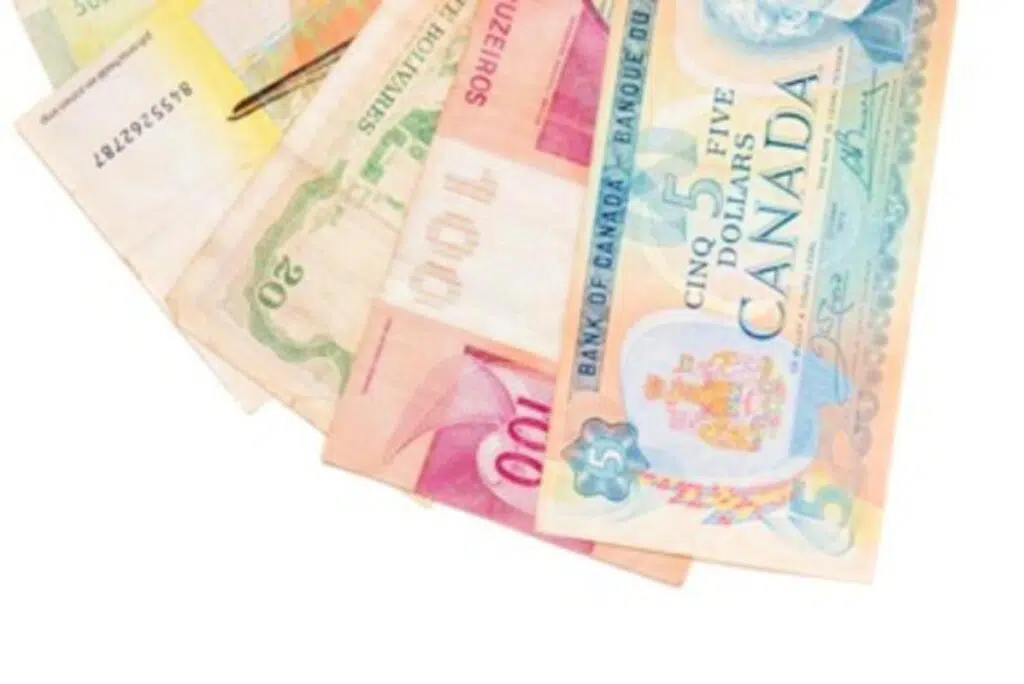
Your local bank will then either send the banknotes to central banks or destroy them.
But specific discontinued banknotes can go for more than their face value, especially if they are rare and of high quality.
So, if you own any discontinued bills, consider having them evaluated by a financial institution that buys rare bills before you consider depositing them at your local bank.
The Devil’s Face
One precious discontinued piece of Canadian paper money is the $1 that the Bank of Canada printed back in 1954.
$1 banknotes from before 1954 can also be valuable, but some $1 banknotes from 1954 are precious.
That’s because the 1954 $1 bills were unusual and, to many Canadians, frightening.
Certain runs of the bills were nicknamed “the Devil’s Face” because, according to these Canadians, the hair of the Queen, whose profile appears on the bill, resembles the devil’s face.
Consequently, the Devil’s Face bills were taken out of circulation and replaced by bills with a slightly altered image of the Queen’s profile dubbed the “modified portrait.”
Nowadays, Devil’s Face banknotes with the right details on the bill, such as an asterisk, can sell for thousands of dollars!
Interestingly, however, the replacement bills can sell for an even higher price, if all the right details are present.
Pinkies
Another precious piece of old Canadian paper money is the discontinued $1,000 bill.
These bills were printed for the first time in 1935, then 1936, 1954, and 1992.
Typically, the $1,000 bills made in 1935 and 1937 sell for the most, as they are scarce and considered collectable. The better the condition, the more they will sell for.
The 1992 $1,000 banknote story is just as interesting as the Devil’s Face banknote story.
$1,000 bills made in 1992 were deemed “pinkies” because of their purplish, pinkish hue.
They had a dubious reputation for being used by criminal organizations to evade taxes, counterfeit, and launder money.
The Royal Canadian Mounted Police asked the government of Canada to discontinue the bill, and the Solicitor General did so officially in 2000.
However, it wasn’t until 2018 that the government of Canada announced that the $1,000 banknote would soon stop being legal tender.
Nowadays, certain pinkies can sell for much more than their face value.