
Table of Contents
- What Is an RESP?
- Understanding 529 Plans
- Key Differences Between RESPs and 529 Plans
- Recent Legislative Changes Affecting 529 Plans
- Choosing the Right Plan for Your Family
- Conclusion


Planning for your child’s education is one of the most significant financial decisions a family can make. With rising tuition and the growing importance of higher education, having a sound savings strategy is crucial. Two widely recognized tools for this purpose are Canada’s Registered Education Savings Plans (RESPs) and the United States’ 529 plans. While both accounts offer unique tax advantages and are designed to support education funding, understanding their key distinctions can help you choose the right plan for your family’s needs. As you consider your options, it’s worth learning more about what can RESP money be used for, which can help you maximize the value of your savings.
Both RESPs and 529 plans offer peace of mind and greater flexibility, but eligibility, contribution rules, and benefits can vary significantly. This guide explores the features, differences, and recent updates affecting both Canadian and U.S. education savings vehicles, allowing you to make informed choices for your child’s future.
Making sense of these education savings options can seem overwhelming at first. However, understanding which plan suits your unique circumstances can bring your family closer to your educational and financial goals. In addition to tuition, both plans cover a range of education-related expenses, offering critical support from elementary and secondary school through various forms of post-secondary education.
Recent legislative shifts—especially changes to 529 plans—have added new options, such as K-12 tuition payments and the potential to roll over unused funds into retirement accounts. Savvy savers will want to stay up to date so they don’t miss out on valuable opportunities.
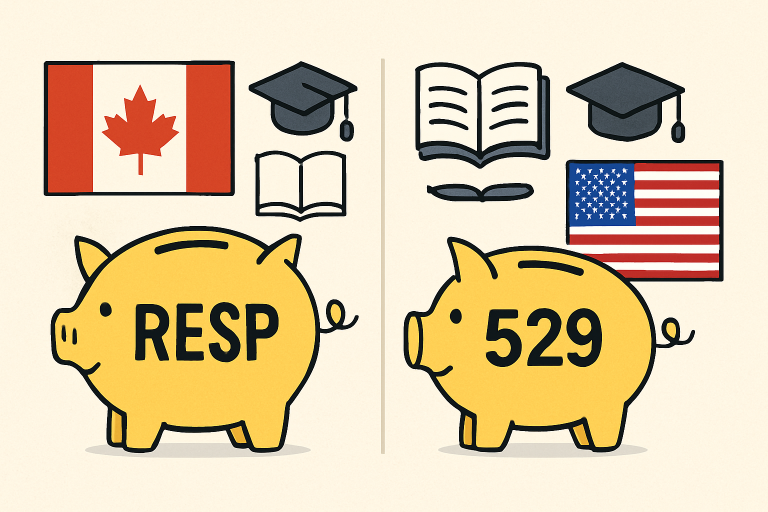
What Is an RESP?
A Registered Education Savings Plan (RESP) is a Canadian government-supported savings account tailored to help families put aside funds for a child’s post-secondary education. You contribute after-tax dollars to the RESPs, and the investments within the account grow tax-free. When your child is ready to pursue higher learning, withdrawals—composed of investment growth and government grants—are taxed in your child’s hands, which typically means paying very little, if any, tax.
What makes the RESP uniquely attractive is the Canada Education Savings Grant (CESG). The government matches 20% of your annual contributions up to $2,500 per child, for a maximum annual grant of $500 and a lifetime CESG maximum of $7,200 per child. Lower-income families may also benefit from the Canada Learning Bond (CLB), a valuable supplement that does not require personal contributions. With broad eligible usages, including certain trade, college, and university programs, RESPs are vital for Canadian families seeking to leverage generous grants and tax advantages.
Understanding 529 Plans
529 plans are the U.S. equivalent of education savings accounts, named after Section 529 of the Internal Revenue Code. They offer tax-deferred growth and tax-free withdrawals when funds are used for qualified educational expenses. These can include tuition, mandatory fees, books, and housing for post-secondary studies. Each state sponsors its own 529 plan, but you’re usually free to select any state’s plan regardless of where you live or where your child plans to attend school.
One standout feature of 529 plans is their expanding flexibility. Whereas the original scope included only college-related expenses, recent legal updates have broadened eligible uses to include K-12 tuition and qualified apprenticeship programs—making 529 plans an appealing option for a wider array of learning pathways. Many states also offer tax deductions or credits for contributions to their own plans, providing meaningful annual tax savings for some families.
Key Differences Between RESPs and 529 Plans
- Government Contributions: RESPs take the lead here, offering direct federal government contributions through the CESG and CLB, while 529 plans depend on state-based incentives and do not feature federal contributions.
- Qualified Expenses: Both RESPs and 529 plans cover traditional college or university expenses, but 529s are now more versatile, allowing for K-12 private school tuition and certain accredited apprenticeship programs.
- Tax Benefits: With an RESP, earnings are taxed at withdrawal, generally in the student’s hands. With a 529 plan, qualified withdrawals are federally tax-free, and many states offer additional tax incentives for in-state residents.
Recent Legislative Changes Affecting 529 Plans
Lawmakers in the United States have recently expanded what’s possible with 529 savings, providing new strategic opportunities for families. Among the most noteworthy changes since 2025:
- Expanded K-12 Coverage: The annual limit for tax-free withdrawals for K-12 expenses has doubled to $20,000. These expenses now reach beyond tuition to include curriculum, standardized testing, and tutoring.
- Eligible Apprenticeship Programs: 529 funds can now pay for registered non-degree apprenticeship programs covering fields like electrical work, carpentry, and HVAC, broadening post-secondary possibilities.
- Roth IRA Rollovers: Families now have the option to roll over up to $35,000 in unused 529 plan assets to a Roth IRA for the same beneficiary, provided the account is at least 15 years old. This offers a smart way to repurpose leftover funds for your child’s retirement savings.
Choosing the Right Plan for Your Family
The choice between RESPs and 529 plans will hinge on several factors: your country of residence, eligibility for grants or incentives, and your family’s long-term educational goals. Canadians will almost always get the best value from RESPs because of substantial federal grants and tax-deferred growth. U.S. families, meanwhile, should review state-level 529 plans for potential tax benefits and the flexibility introduced by recent legislative changes.
When building your education savings strategy, review each plan’s limitations and potential, including changes that might have occurred in the last legislative session. A financial advisor or education planning specialist can offer insight and structure a plan that reflects your family’s aspirations, risk tolerance, and economic situation.
Conclusion
Both Canadian RESPs and U.S. 529 plans are powerful vehicles for making educational dreams attainable, but the best choice depends on your unique circumstances. By understanding their differences, recent updates, and how government incentives work in your favor, you can confidently map out a path that supports your child’s educational future.