
No, the piano isn’t a particularly hard instrument to learn. Anyone with an interest in music can become proficient at an intermediate level.
However, it takes regular practice, discipline, dedication, hard work, and a willingness to challenge yourself.
According to the Joe Ferrante Music Academy which teaches music lessons in Monrovia, CA, the piano “requires a focused hard work and mental discipline, coupled with critical thinking and imagination.”
Learning the basics is very achievable for most while mastering the techniques necessary for advanced piano playing will be more challenging.
But even so, with the correct approach and commitment, anyone can reach an advanced level of piano playing.

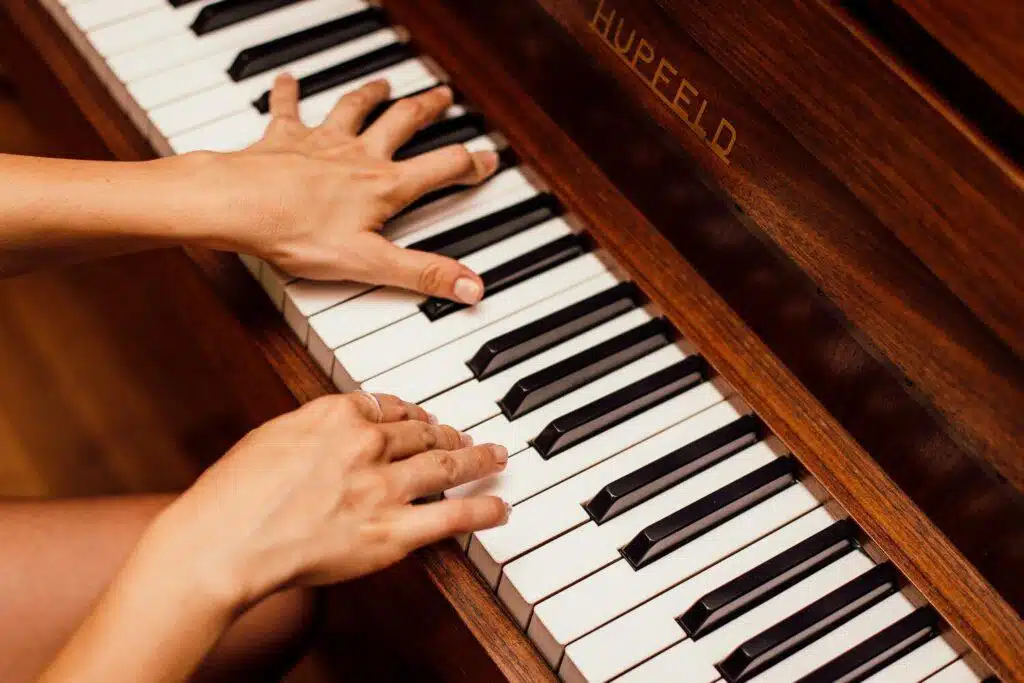
Skills Needed to Learn the Piano
Learning the piano requires a combination of focus, mental discipline, and dedicated time. An aspiring pianist must be able to execute simultaneous tasks, such as reading music, coordinating both hands, maintaining a steady tempo, and more.
A certain level of focus is essential for achieving precision and fluidity across these many tasks.
Furthermore, mental discipline plays a crucial role in having patience with oneself, overcoming frustration, and staying motivated throughout the learning journey.
Always keep in mind that making progress on the piano happens incrementally and requires patience and perseverance.
Ultimately, learning to play the piano is a testament to one’s commitment and resilience, shaping musical abilities and personal growth.
How Long Does It Take to Learn the Piano?
It can take a year to learn just the basics of the piano. In general, the amount of time it takes to learn the piano depends on a variety of factors, including the learner’s level of commitment and aptitude.
Learning the basics can take about one year if consistently practiced at least 20-30 minutes per day. After mastering the basics, playing more advanced pieces requires several years of study.
Reaching an Intermediate Level in Piano
Any age, from four to 100, and with any background can achieve piano proficiency at least at an intermediate level.
It doesn’t take any “special talent” to learn how to play the piano. It simply takes a willingness to learn, focused attention, and a daily practice routine guided by a great teacher.
As you become comfortable with the basics, you’ll gradually increase the difficulty of songs and repertoire you’ll be able to play.
Taking Your Piano Skills to an Advanced Level
The commitment and mental focus required will be much greater for those wanting to go beyond intermediate proficiency and become an advanced pianist.
This includes both the time and effort put into practicing as well as building an understanding of music history, the overall musical repertoire, and music theory.
Some advanced pianists possess skills include sight-reading (play music you’re seeing for the first time), improvise and/or arrange pieces of music into new unique arrangements, understand chord progressions, play chamber music with other musicians, and perform advanced repertoire.
As your skills increase you may even consider playing in an orchestra or performing a concerto as the soloist with an orchestra.
Progressing to an advanced level on the piano is difficult, but can also be an incredibly rewarding journey, allowing you to perform in public and potentially play or teach piano professionally.
How to Learn to Play the Piano
Find a Local Piano Teacher
An in-person, local teacher can be incredibly helpful and even crucial in providing the necessary guidance and structure to your study of the piano. A qualified, degreed piano teacher can set up a detailed plan that fits your goals and guide you through each step, one lesson at a time.
They will also provide you with the materials, exercises, and works to practice and help establish the order in which such works should be studied to progress most efficiently.
A qualified teacher will also help identify improvement areas as they present themselves.
Most importantly, an in-person piano teacher can demonstrate new techniques right before you while providing specific feedback that an online teacher will struggle to demonstrate effectively over a virtual teaching medium.
Take Online Piano Lessons
Online piano lessons are a good option for students ages 13 and up who may live in more rural areas without a piano teacher, for those in dense urban spaces with difficult commuting times, or for those with household childcare challenges or busy work schedules that make learning from home considerably easier to facilitate.
Online piano lessons generally are not recommended for students under the age of 13 as developing the mental discipline and focus to learn the piano is much easier for young students to do in person.
The best way to study piano online is to find a degreed instructor who will give you live (not asynchronous) weekly private lessons.
Under his/her guidance, you will create a structure together for your regular learning and practicing.
If you can stick to your online lesson commitments and set aside a consistent amount of time every week for practice, online learning can be a great option for many students of all experience levels.
In Conclusion
Learning to play the piano is an achievable goal for anyone with dedication and focus.
While it can be difficult to reach an advanced level of playing, this challenge has its rewards in terms of musical and personal growth.
If you’re looking to play the piano, you can decide whether you’d like to take in-person or online lessons, depending on your schedule, location, the student’s age, and other factors unique to your household such as childcare or commuting times.
Best of luck on your musical journey!