


Key Takeaways
- Functional fitness prepares your body for everyday life by improving strength, balance, and flexibility in practical movements.
- Resistance bands are a powerful, versatile, and portable tool that elevate functional training for all fitness levels.
- Resistance bands can enhance muscle activation, support injury prevention, and boost mobility.
- Simple resistance band exercises can be integrated into daily routines to make real-world tasks easier and safer.
Table of Contents
- Understanding Functional Fitness
- The Role of Resistance Bands in Functional Training
- Benefits of Using Resistance Bands
- Integrating Resistance Bands into Daily Movements
- Sample Resistance Band Exercises
- Scientific Support for Resistance Band Training
- Incorporating Bands into Various Fitness Levels
- Final Thoughts
Understanding Functional Fitness
Functional fitness highlights the importance of training our bodies for real-life activities. By improving the way muscles work together, people strengthen the movement patterns they rely on every day—such as bending, lifting, pushing, and pulling. A functional fitness routine doesn’t focus solely on aesthetics or isolated muscle development but aims to build practical, total-body strength. For those seeking expert guidance, Alexandra Chipurnoi provides valuable tips for getting started with resistance band exercises designed for strength and mobility.
Incorporating functional movements into your training routine can reduce the risk of daily injuries, support joint health, and enhance mobility. This is especially important as we age, when maintaining independence often comes down to being able to carry groceries, climb stairs, or reach for items overhead. Resistance bands are integral in making these everyday motions safer and more efficient.
The Role of Resistance Bands in Functional Training
Resistance bands are versatile tools that enhance any functional fitness program. Designed from stretchy elastic material, they come in various resistance levels, ranging from lightweight to extra heavy. They offer a unique form of resistance that differs from traditional weights—rather than relying on gravity, bands provide tension throughout the entire range of motion, which leads to constant muscle engagement.
Their adaptability means resistance bands can be used for upper-body, lower-body, and full-body exercises. They’re exceptionally portable, making them a travel-friendly choice for busy individuals or anyone without regular access to a gym.
Benefits of Using Resistance Bands
- Enhanced Muscle Activation: The continuous tension from resistance bands recruits more muscle fibers, especially stabilizer muscles, than free weights.
- Improved Mobility and Flexibility: Using bands during dynamic stretching increases range of motion, which is crucial for everyday tasks and injury avoidance.
- Injury Prevention: By targeting smaller stabilizing muscles and improving joint support, bands help decrease the likelihood of strains or overuse injuries.
- Progressive Overload: Bands are available in varying resistances, allowing gradual progress and consistent challenge as fitness levels improve.
- Accessibility: Resistance bands are cost-effective and suitable for a wide range of users—from beginners to elite athletes.
Integrating Resistance Bands into Daily Movements
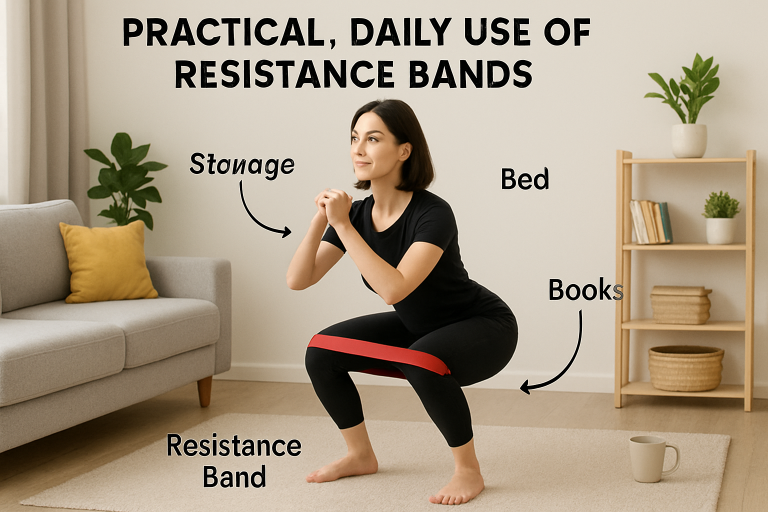
Embedding resistance bands into your daily activities is an efficient way to build functional strength. For example, adding a resistance band around the thighs during squats intensifies the workout and translates to practical strength when lifting heavy objects at home or work. Lunges with bands can mimic the movement of climbing stairs, while banded rows strengthen the pulling motion you rely on when opening doors or moving furniture.
By targeting pivotal muscle groups in daily motions, resistance band exercises improve balance, stability, and muscle coordination, ultimately fostering more seamless and safer movement patterns throughout the day.
Sample Resistance Band Exercises
Banded Squats
Loop a resistance band above your knees and perform squats. This added resistance recruits more glute and quad engagement, helping support posture and hip stability for activities like bending, sitting, and lifting.
Standing Band Rows
Anchor the band at chest height. Stand with feet hip-width apart, grip the handles or ends, and pull the band toward your torso, keeping elbows close to your body. This motion targets your upper back, shoulders, and biceps—key for pulling and lifting motions.
Lateral Band Walks
Place a resistance band around your ankles or just above your knees. Assume a quarter-squat position and take slow, controlled steps to either side. This strengthens the hip abductors and improves lateral stability, critical for balance and joint protection.
Scientific Support for Resistance Band Training
Research strongly supports the inclusion of resistance bands in functional training programs. According to studies published in the Journal of Strength and Conditioning Research, participants who implemented resistance bands into their workouts observed measurable improvements in strength, balance, and coordination. Bands not only induce similar muscle activation as free weights, but also aid in activating stabilizer muscles due to increased time under tension, which is fundamental for injury prevention and greater athleticism.
Incorporating Bands into Various Fitness Levels
Resistance bands ensure inclusive fitness, whether you are a newcomer to exercise or a well-conditioned athlete. Beginners may start with lighter bands and basic movements, establishing foundational strength and learning proper form without the intimidation factor of heavy weights. As skills progress, heavier bands or combination moves can be introduced, allowing for infinite progression and customized intensity.
Advanced users often supplement resistance bands with free weights or use them for explosive plyometric and sport-specific drills, ensuring that even the most seasoned athletes experience a unique and continual challenge.
Final Thoughts
Resistance bands are a dynamic addition to any functional fitness routine, helping to improve real-world strength and flexibility and protect against injury. Their portability, adaptability, and effectiveness make them a staple for anyone aiming to boost the quality of their daily life. By making resistance band training part of your regular practice, you take a proactive approach to wellness, equipping your body to handle whatever challenges each day brings.