
Most scrapbooks begin the same way, with the fun stuff.
Flipping through papers, sorting photos, saving ideas somewhere you’ll actually remember to look. There’s usually a running mental list of everything you want to include, and for a while that list is enough.
At some point though, the practical question comes up. Where is everything going?
It seems like a small thing to figure out, but the album choice affects almost everything that comes after.
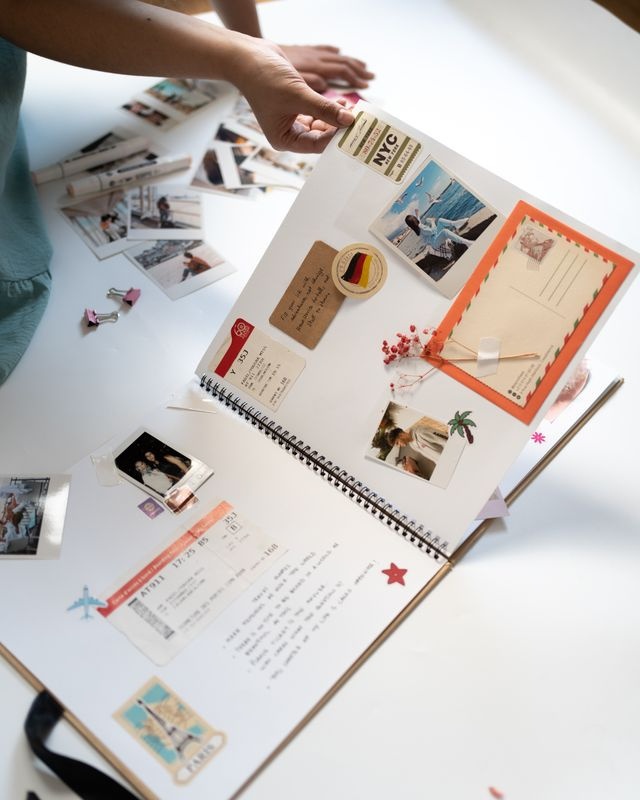
Something built around printed photos and flat decorations is a completely different animal than a project stuffed with pockets, tags, bulky keepsakes, and layered paper. Treating them the same way tends to cause headaches later.
Take Stock of What You’re Actually Including
The easiest way to narrow things down is to look at what you already know you want to include before you start shopping.
A stack of printed photos has different needs than a collection that has travel souvenirs, old handwritten notes, or physical memorabilia.
If your pages tend to get dimensional with stickers and die cuts piled on top of each other, that takes up real space. If you usually keep things flatter and cleaner, you can get away with a lot less room.
Smaller albums work well when a project has a clear boundary around it, one trip, one event, one person. When you know the collection is only going to grow, something with more capacity saves you the trouble of figuring out an overflow situation later.
How You Work Is Part of the Equation
Give the same photos to different people and the results won’t look anything alike.
Some people build pages that stay spare and photo-focused. Others end up with something closer to a collage, interactive pieces, folded elements, textures competing for attention. Neither is better, they just need different things from an album.
If you already know your pages tend to get heavy and layered, cramped pages will drive you crazy. If restraint is more your natural mode, a massive album is probably overkill.
The Album Needs to Fit Your Supplies Too
Creative pieces get most of the attention when a project is getting started, and the album ends up being a last-minute call. That order tends to backfire.
Spending even a little time comparing formats and sizes before committing makes everything easier to plan. You know what you’re working with, how much page space is realistic, and whether the format actually suits the project or just sort of fits.
It also makes adding pages later a lot less painful. Forcing a growing project into a format that was never quite right gets old fast.
Starting Before You Have Answers Is Fine
Projects change. That’s just the nature of them.
What starts as a few photos turns into a bigger collection than expected. A page meant to stay simple becomes the right place for an extra note or a ticket stub that would otherwise get lost. Something that felt obvious at the planning stage looks completely different once it’s all spread out.
None of that is a setback. Honestly, it’s how most projects actually develop.
Albums hold the finished version of a story, but that story usually figures itself out somewhere in the middle of the process. A format with a little room to flex means those shifts don’t become problems.
Getting started is the part that matters most. The rest tends to work itself out.